
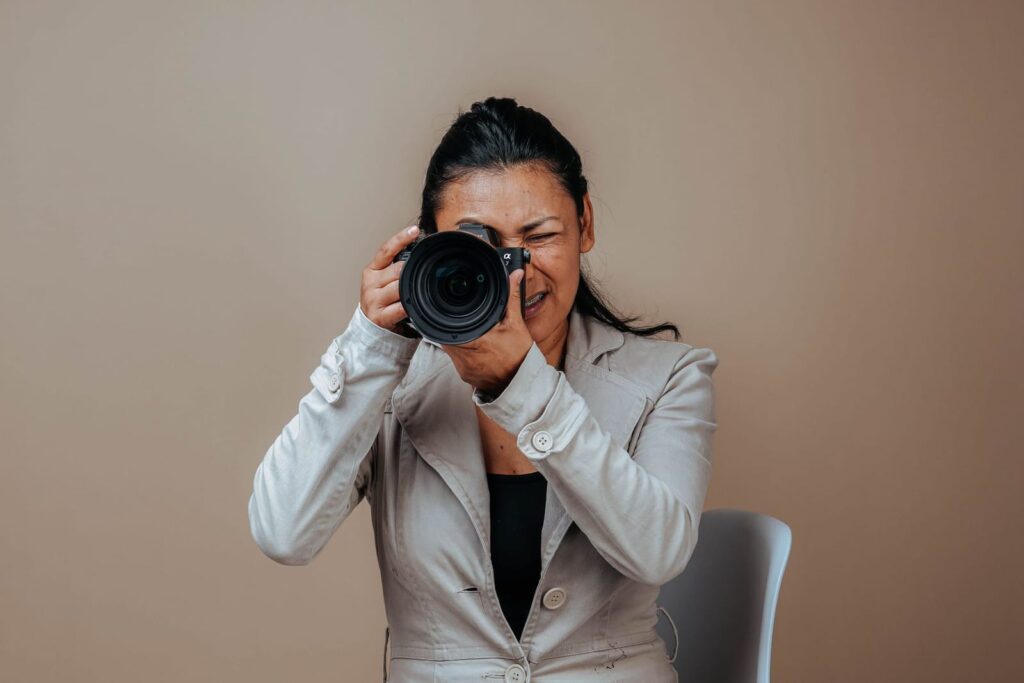
The lens you choose has more influence on a portrait than the camera body behind it. Focal length changes the shape of a face, the relationship between subject and background, and even how comfortable your subject feels with you standing close or far away. Aperture controls how much of the background melts into blur. This guide explains the best lenses for portrait photography by focal length and type, so you can choose the right one for your style and budget.
Why focal length matters for portraits
Focal length on its own does not distort a face. What changes the look is the distance between the camera and the subject, which focal length encourages. With a wide angle lens, you stand very close to fill the frame with a face, and at that distance features nearest the lens, such as the nose, appear larger. With a longer lens, you stand further back, and facial proportions look more natural and flattering. Longer lenses also make the background appear closer and larger behind the subject, an effect often called compression.
A note on sensor size: the focal lengths below refer to full frame cameras. On APS-C cameras, multiply by roughly 1.5 (or 1.6 for some brands) to get the equivalent field of view, and by 2 for Micro Four Thirds. A 50mm lens on an APS-C body frames like a 75mm to 80mm lens on full frame.
The 50mm prime: the best place to start
The 50mm lens, often called the “nifty fifty”, is many photographers’ first portrait lens. Versions with a maximum aperture of f/1.8 are among the most affordable lenses most camera makers offer.
- Strengths: small, light, sharp and bright. The wide aperture gives background blur and works well in low light.
- Best for: environmental portraits, half body shots, street portraits and everyday photography.
- Limitations: for tight head shots you need to stand fairly close, which can slightly enlarge features nearest the lens.
The 85mm prime: the classic portrait lens
The 85mm focal length is widely considered the classic portrait lens. It lets you stand at a comfortable conversational distance while filling the frame with head and shoulders, and it renders faces with flattering proportions.
- Strengths: natural facial proportions, beautiful background separation, especially at f/1.8 or wider.
- Best for: head and shoulders portraits, headshots, outdoor portraits with blurred backgrounds.
- Limitations: needs more working space than a 50mm, which can be tricky indoors.
The 35mm prime: portraits with context
A 35mm lens shows more of the environment, making it a favorite for documentary style and lifestyle portraits where the setting tells part of the story.
- Best for: environmental portraits, street photography, weddings and storytelling.
- Limitations: keep some distance from your subject and avoid placing faces at the edges of the frame, where wider lenses can stretch features.
The 105mm and 135mm primes: maximum separation
Longer primes such as 105mm and 135mm produce strong compression and very smooth background blur. They are popular for tight headshots and outdoor portraits where you want the background to dissolve completely.
- Best for: headshots, outdoor portraits, fashion and beauty work.
- Limitations: you need plenty of space, and communicating with your subject from a distance takes more effort.
The 70 to 200mm zoom: the versatile workhorse
A 70 to 200mm zoom with a constant f/2.8 aperture is a staple for wedding, event and outdoor portrait photographers. It covers the classic portrait focal lengths in one lens and lets you reframe quickly without moving.
- Strengths: flexibility, strong compression and good background blur at the longer end.
- Limitations: large, heavy and more expensive than primes. f/4 versions are lighter and cheaper but gather less light.
Standard zooms: 24 to 70mm
A 24 to 70mm zoom covers wide to short telephoto and is common among event and wedding photographers. It is not a specialist portrait lens, but at 70mm it produces pleasing portraits, and its range makes it useful for groups and environmental shots.
Quick guide by portrait type
| Portrait type | Good focal lengths (full frame) |
|---|---|
| Environmental and lifestyle | 35mm, 50mm |
| Half body and full body | 50mm, 85mm |
| Head and shoulders | 85mm, 105mm |
| Tight headshots | 105mm, 135mm |
| Weddings and events | 24 to 70mm, 70 to 200mm |
Aperture and background blur
Wider apertures (smaller f numbers such as f/1.4 or f/1.8) create a shallower depth of field, which blurs the background and draws attention to the eyes. Very wide apertures demand accurate focus, so use eye detection autofocus if your camera has it. For portraits of groups, or when you want the whole face sharp, stop down to f/2.8 to f/5.6.
Prime or zoom?
Primes are usually sharper, lighter and brighter for the price, and they encourage you to move and think about composition. Zooms offer flexibility and speed when you cannot move freely. Many portrait photographers own one bright prime, such as a 50mm or 85mm, and add a zoom for events.
Which lens should you buy first?
If you are new to portraits, an affordable 50mm f/1.8 is an excellent first lens: inexpensive, sharp and versatile. When you want the classic portrait look, an 85mm f/1.8 is the natural next step. Beyond that, choose based on how you shoot. Your style should guide the lens, not the other way around.